Within the careers and programs offered by the UDP there is an international approach that allows us to articulate our students and the academic establishment with relevant actors in the world, ensuring that our teaching and research is articulated with relevant and pertinent themes and contents worldwide. . In order to train global citizens, the creation and strengthening of an international and internationalized academic offer is an impediment, through strategies of internationalization of the curriculum that allow integrating pedagogical strategies, bibliography and/or languages that facilitate an approach to diverse cultural realities. . This is directly visible within the study programs through different actions and mechanisms for the internationalization of learning processes, such as:
- Include teaching and learning activities with an international perspective.
- Use international teaching materials and resources.
- Integration of an international, intercultural and/or global dimension in learning outcomes.
- Facilitate the comparative study of international practices, regulations and good practices.
- Inclusion of international teachers in teaching activities to facilitate access to international knowledge.
- Integration of a second language in the classroom.
- Use virtual tools to generate online international collaboration spaces between UDP students and students in other parts of the world.

At UDP, through the International Relations Office, some specific global training mechanisms are promoted in particular as strategic actions. Currently there is institutional support for what is the internationalization of learning processes through the COIL methodology: International Online Collaborative Learning. You can review an informative flyer (in spanish) about COIL and if you want to know more about its scope and possibilities, we recommend you contact us at [email protected]
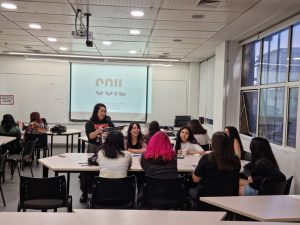
The In-Person Mobility Fund for COIL Projects was established by the General Office of International Relations (DGRI) to support and promote international relations among peer faculty members who actively teach Virtual Exchange projects. It seeks to complement these experiences by deepening academic and teaching ties. This is the first call of its kind, inviting project applications to ensure the continuity of a virtual exchange that has been successfully implemented at least once.
-
- What is the objective of this fund? This fund aims to complement virtual exchange experiences with an in-person visit between the faculty members leading these initiatives, thereby strengthening collaborative ties for future projects. This fund requires applicants to pitch the in-person mobility by submitting a work agenda for a visit to the partner institution—or an invitation for the partner to visit UDP—lasting between 3 and 5 days. The work agenda must showcase the importance of the visit (whether hosting or travelling) for the future of the COIL project and commit to future, measurable, and impactful achievements resulting from the in-person mobility. The main goal is to robustly strengthen the contact between UDP and its international partners collaborating on COIL projects, projecting these relationships into the medium and long term to foster sustainable and substantive relations.
- What can be financed with this fund? Eligible expenses include airfare, hotel accommodations, and potentially costs for promotional activities for the visit and/or the organisation of events, such as a seminar associated with the COIL project. The funding amount awarded per project will be evaluated based on the destination and associated costs, up to a maximum cap of 2,500,000 CLP. This must be properly justified with a detailed expense plan, using the template attached to the guidelines in the application form.
Examples of projects and activities that could be proposed include, but are not limited to:
- Expenses associated with an in-person seminar at the partner university (or UDP) on the topic addressed in the COIL project among its students, combined with an agenda of meetings and encounters with authorities and peers to strengthen teaching and research ties.
- Expenses associated with technical meetings to review potential innovations aimed at increasing the impact and quality of a previously implemented COIL project.
- Expenses related to field visits connected to the COIL project content to foster new ideas that can enrich future projects and/or lead to innovation within them.
- Expenses associated with faculty training on teaching methodologies where the partner institution holds key strengths, which will benefit the quality of their joint COIL course in terms of both the faculty and student experience.
- Project Focus: Projects need to be aligned with and strengthen the implementation of institutional frameworks and policies. This includes the Global Education and International Mobility pillars of the Internationalisation Policy, which seeks to strengthen and implement internationalisation actions at UDP that ensure global education for the entire student body, granting a larger portion of the student population access to developing international and intercultural competencies and knowledge. These projects are also expected to support academic units in achieving their strategic goals related to teaching and internationalisation, and, in general, to contribute to their academic project. Finally, it is crucial for projects to deliver concrete results during and after the visit, in line with the COIL project and its associated objectives.
Undergraduate or postgraduate professors, whether full-time, part-time, or adjunct (hourly), are eligible to apply for this fund.
Review the call guidelines HERE.
Applications are open until May 30; submit this form to [email protected] with the subject line “COIL Mobility Fund 2025”.
Each year, the General Office of International Relations, in collaboration with the Academic Vice-Presidency and its Office of Curriculum and Faculty Development, conducts faculty training workshops focused on internationalisation. To date, three editions have been held, with more than 100 participating faculty members who have completed applied workshops on curricular internationalisation mechanisms, aimed at fostering the integration of the international dimension across the various levels of students’ academic education. For each edition, a call for registrations is sent en masse to the entire teaching staff to promote broad training on this topic. However, if you have a specific interest or inquiry, you can always write to us at [email protected].
More information about the workshops is available on the Office of Curriculum and Faculty Development page HERE.
In addition, it is worth noting that internationalisation is part of the Faculty Guide, which can be reviewed here.
At UDP, through the work of the General Office of International Relations, specific global education mechanisms are promoted as strategic actions. Currently, there is institutional support for the internationalisation of learning processes through the COIL (Collaborative Online International Learning) methodology. In this link, you can review an informative flyer about COIL to learn more about its scope and possibilities.
It is important to note that any faculty member who wishes to implement a COIL project must notify the DGRRII in advance. This is necessary to register essential data and to conduct a review to ensure compliance with specific institutional quality criteria and standards. Furthermore, this allows instructors to access a range of institutional support from both the DGRRII and the VRA for the project’s design and implementation phases, while ensuring that the impact of the COIL experience is measured and recorded in institutional indicators.
Would you like to see which projects were previously implemented at UDP for inspiration? Check out the COIL project repository here.
For any questions, we recommend contacting us at [email protected].
The fund for Internationalisation of Learning Processes projects was created as a joint initiative by the General Office of International Relations (DGRI) and the Office of Curriculum and Faculty Development (DDCD). Its goal is to support and promote the mainstreaming of actions that integrate an international, intercultural, and/or global dimension into undergraduate study plans, thereby ensuring the development of international, intercultural, and global learning. This fund aims to establish and foster the mainstreaming of internationalisation within learning processes at UDP through an inclusive approach. It paves the way for implementing actions that promote internationalisation within and from UDP without the need to leave the country, granting more students access to international environments—in this case, online. The main purpose of this initiative is to enhance learning as well as professional and disciplinary training by incorporating an internationalisation dimension into teaching. This second call invites applications for virtual exchange projects, with a strategic focus on those that incorporate the Collaborative Online International Learning (COIL) methodology.
- Call Summary:
-
- The call for applications opens once a year (usually in May) for Internationalisation of Learning Processes projects that focus on virtual exchanges through the COIL approach.
- Guidance and support are provided by the DGRRII and the VRA.
- You can apply with or without an international partner (the DGRRII provides advisory support to help you find one).
- 800,000 CLP for new projects and 400,000 CLP for projects seeking to innovate and improve existing ones.
- Email [email protected].
Thanks to the work carried out by the Internationalisation Committee, a consensus has been reached on a set of indicators to be used at UDP to measure and assess curricular internationalisation. This instrument was reviewed and validated by the Academic Vice-Presidency and is being used for the first time in 2024 as part of curriculum redesign processes. It also serves as a guide for existing majors and programmes wishing to diagnose their level of internationalisation across different areas:
- Rationale and Graduate Profile
- Curricular Structure
- Management and Support Mechanisms
- Syllabi and Study Programmes
Based on this list, a diagnostic rubric has been operationalised to enable in-depth analysis of each level and to provide tools and suggestions for integrating the international dimension into curricular methodologies, purposes, and pedagogy.